
Where manuka comes from
What a hive can reach
A honey bee works the flowers around its hive. So the honey in the bottle is a map of what was flowering within reach. Drop a hive anywhere on the Cooloola coast and see what the bees would find, month by month.
Drop a hive
Share of the land in reach, from the vegetation mapping. The hive is made up: this is a map of what grows, not of where our hives are.
From this coast
Our manuka, tested batch by batch
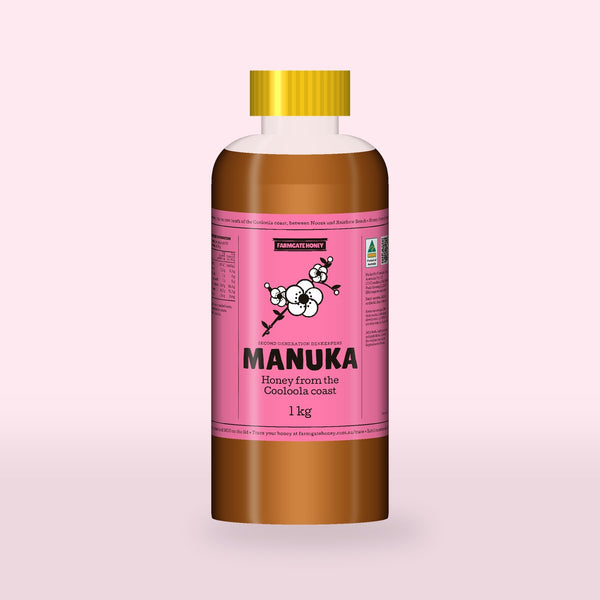
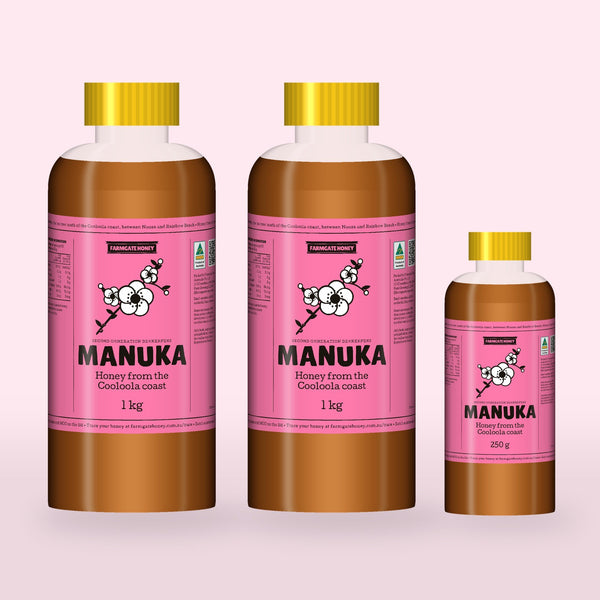
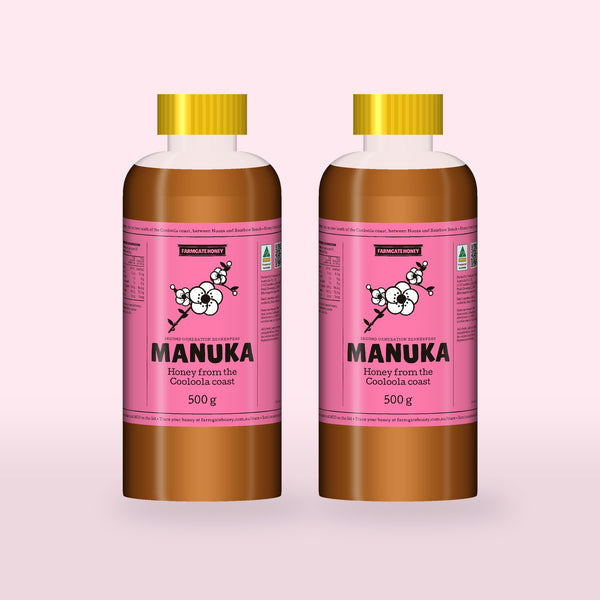
Two batches are at the lab now, one from Rainbow Beach and one from Noosa. Each bottle carries its batch's number, from its own certificate.
When the heath flowers
The manuka window runs August to January and peaks in spring. The trick is catching the tea trees without the gums.
| J | F | M | A | M | J | J | A | S | O | N | D | |
|---|---|---|---|---|---|---|---|---|---|---|---|---|
| Tea tree heath | ||||||||||||
| Scribbly gum forest | ||||||||||||
| Wallum banksia | ||||||||||||
| Paperbark swamp |
Darker is the main months. From the NSW flora and south east Queensland herbarium collections, not a Cooloola record, so our own hive notes will beat them. The other kinds of country flower on timetables we haven't charted yet.
Why every batch is different
That's why every manuka batch is tested on its own, and why the code on its lid opens its results on the trace page.
For a class
Honey, maths and maps in one lesson, for upper primary and up.
- Drop a hive, pick a month and print. It comes out as one A4 sheet at 1:500,000, so 1 cm on the paper is 5 km, and the ring is to scale.
- Colour in or tally each kind of country inside the ring.
- What would the bees bring home that month? Would it be manuka?
- Move the hive 3 km (6 mm on the paper) and print again. What changes?
- Vegetation: Queensland Government regional ecosystem mapping, grouped into eleven kinds of country by their official short descriptions. "Tea tree heath" is a heath, sedgeland or shrubland whose description lists a tea tree (Leptospermum, Aggreflorum or Gaudium). Mapped at about 1:100,000, so it shows the main plants, not every shrub; jelly bush along a creek can be missed.
- Flowering: PlantNET (the NSW flora), EUCLID and Atlas of Living Australia collection months. Scribbly gum flowers mainly late winter to spring, with some summer flowering.
- Reach: Visscher and Seeley (1982, Ecology) read a colony's dances: half its foraging was within 1.7 km, and 95% within 6 km. Bees fly further when there is less close by.
- The blend figure: Cokcetin and others (2016, PLOS ONE), 80 Australian honeys.
- Flows: Australian Honey Bee Industry Council, on the ABC (2015).
- Coast, lakes and place names: Queensland Government. Drawn in Farmgate's ink hand.
Guess the MGO
Nobody knows the number yet. Not even Murray.
Our first two manuka batches, one from Rainbow Beach and one from Noosa, are at the lab. Put in your guess and your email. The day the certificate lands, we'll email you the real number and how close you got.
For teachers
Using this map with a class?
Tell us, and we'll send you the next class activity when it's ready.